



The Impact of AI Coding Tools on Junior Developers in the Job Market
The Impact of AI Coding Tools on Junior Developers in the Job Market
By Charlotte Mateo On April 21, 2026 · In Candidate Advice
Updated: May 6, 2026
How do you maintain a massively popular app with 751 million active users while shrinking your development team? Just ask Spotify. In a February earnings call, they said their best developers haven’t written a line of code since December, instead using an internal AI tool called “Honk” to accelerate coding and launch a slew of new features.
They’re not alone in this trend. Google, Meta, and Microsoft publicly admit they’re using AI generated code, while other tech companies quietly embrace AI coding assistants behind the scenes. At this point, just about every major application that enterprises and consumers use is touched by AI coding.
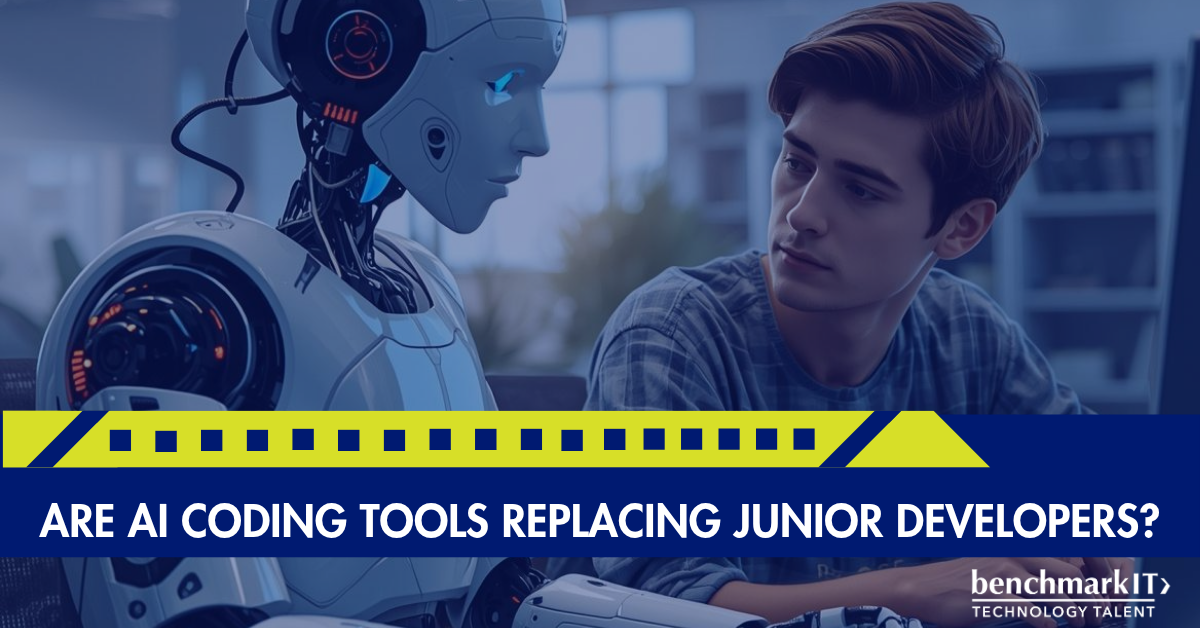
So, if development teams increasingly consisting of senior-level talent shepherding generative AI, where does that leave entry-level coders? Entry-level developers aren’t obsolete, but the skill sets, training programs, and career path for the profession has to change.
For that, we’ll need tech leaders, educators, and the next generation of coders to rethink entry-level development roles to keep this career sought after.
AI Coding Assistants Are Taking Tasks Junior Developers Would Do
Tech professionals are early adopters by nature, so many developers have already integrated AI coding assistants into their workflows. We see that in the 2025 Stack Overflow Developer Survey, where 47.3% of experienced developers said they used AI tools daily and 17.2% used them weekly. The top uses for AI are to search for answers, generate content, and learn new concepts, but some senior developers still use AI for work junior developers would have done:
- Writing and testing code — Tasks that once kept junior developers busy for entire sprints are now handled in minutes. And if projects are straightforward or teams have enough seasoned coders on staff, companies might forgo hiring entry-level talent.
- Debugging code — Testing code and fixing bugs used to require too much time for senior staff to complete, so junior developers had a learning opportunity and a critical function in the process.
- Documenting code — Very few senior developers we’ve talked to want to spend their time writing code documentation, which made this type of task a classic entry-level responsibility. Now AI handles it automatically, reducing the demand for new hires.
- Taking code live – Junior developers would have done the hands-on work configuring environments, running checklists, and catching last-minute errors before launch. Now AI-assisted deployment tools automate much of that workflow, leaving less room for entry-level engineers to learn the ropes.
What about the horror stories of AI coding gone wrong? Rumor has it that recent AWS issues are the result of system changes made by their Kiro agentic AI tool, despite Amazon insisting on the contrary. Or there’s the story of the developer who watched Claude Code destroy his site’s live environment after being tasked with updating the website.
For the most part, industry leaders appear to be learning from these snafus as Amazon introduces guardrails requiring “engineers to document code changes more thoroughly and secure additional approvals.” Even with a more proactive human in the loop, we don’t anticipate a full reversal to pre-AI hiring levels.
Though not an outright replacement, AI code assistants are allowing organizations to trim down their team size. So, a four-person development team may now be able to handle work that previously would have required hiring a fifth person. And that reduction compounds down the line.
Changes to the Developer Job Market
So, what has that done to the job market? Three or four years ago we would have told young people interested in STEM that software engineering was a smart career investment. Even junior developers were hired quickly for competitive salaries. Now, the demand has tapered off, and entry-level developers are job searching for longer.
This is more than just our anecdotal experience. A Stanford study exploring the effects of AI on employment trends reflects the decline in entry-level hiring. Between 2022 and 2025, early-career workers in AI-exposed fields saw a 16% relative employment decline while experienced workers in the same roles stayed stable.
And it points to a bigger trend: tighter budgets are pushing companies to bet on experience over untested talent. While this approach might be mortgaging the talent market’s future, it’s understandable as companies scramble to stay afloat in the face of economic turbulence. Chris Murphy, Senior Lecturer in Computer Science at Columbia University, pointed out in an interview how this could backfire:
“Regarding AI replacing entry-level jobs, an Engineering Manager at a large tech company told me that she has concerns about not hiring recent grads and early-stage programmers, because her organization has a process of helping them advance their careers and take on more responsibility. Her point is that if there are no entry-level programmers now, who will be the mid-level programmers in five years?”
Preparing the Next Generation of Entry-Level Developers
The future of software engineering is going to require structural reimagination. AI coding assistants are now integral to the job, so universities and bootcamps alike need to incorporate them into training programs and curricula. From what we’re seeing, premier organizations are already taking reassuring steps in the right direction.
Some universities recognize the need to weave AI into the foundation of their coursework. For example, Columbia Engineering students will learn how to use AI to write, tweak, debug, and test programs. More than just using the tool, students will learn to understand code and practice computational thinking. The University of California San Diego will also be building upon their growing AI-informed CS education through their Gen AI in CS Education Consortium. Approaches like these empower students to avoid cognitive offloading and intervene when AI is wrong.
We also see bootcamps and upskilling programs step up to the plate to fill the AI-assisted coding skills gap. The right bootcamps allow students to learn about both their chosen programming language and AI best practices. Plus, upskilling programs like dae offer personalized pathways for students, building their technical skills as well as professional competencies, preparing them to reason through challenges, not just accept the answer AI gives them.
Last but not least, there’s an opportunity for young developers to experiment with AI tools themselves. Test driving tools on hobby projects is often a great way for entry-level coders to identify an AI model’s strengths, pinpoint its weaknesses, and verify their own knowledge.
In fact, working on 50 projects across Claude Code and Claude Opus Benj Edwards, Senior AI Reporter at Ars Technica, stumbled upon insight that we think will define how the next generation of coders stays competitive:
“Even with the best AI coding agents available today, humans remain essential to the software development process. Experienced human software developers bring judgment, creativity, and domain knowledge that AI models lack. […] For hobby projects like mine, I can get away with a lot of sloppiness. But for production work, having someone who understands version control, incremental backups, testing one feature at a time, and debugging complex interactions between systems makes all the difference. Knowing something about how good software development works helps a lot when guiding an AI coding agent.”
This lines up with our own experience as an IT staffing firm over the last 19 years. The best software developers are people who develop a critical eye, think creatively, and build deep domain knowledge. AI coding assistants just build on the development talent people are willing to cultivate.
Are you thinking about hiring an entry-level software developer? Are you looking to double check your compensation averages before accepting an offer? Download our 2026 Salary & Hiring Guide to inform your search.
TAGGED WITH → Candidate Advice·Hiring Advice·IT Career·Job Market·Technology Talent