



Which Recruitment Tasks Are Best Automated — and Which Should Stay Human?
Which Recruitment Tasks Are Best Automated — and Which Should Stay Human?
By Charlotte Mateo On January 14, 2026 · In Uncategorized
Updated: January 14, 2026
Artificial intelligence has quickly moved from buzzword to becoming baseline in the recruiting world. More than 67% of organizations now use AI in some stage of their hiring process, and among those who do, 98% report seeing measurable efficiency gains. AI is accelerating sourcing, screening, scheduling, and administrative workflow – and it’s reshaping how recruiters spend their time.
But while AI now plays a key role in recruiting operations, the core of great hiring still relies on human judgment, empathy, and intuition. Technology can scan thousands of resumes in seconds – but it cannot understand the nuance of motivation, the subtleties of communication style, or the cultural realities inside a team. At Benchmark IT, we’ve seen the most successful outcomes when AI enhances the process and humans elevate the outcome.
The goal isn’t to use automation as a crutch for avoiding human-led recruitment searches. The goal is to create a faster, fairer, more strategic hiring process that helps us deliver the right candidate to our clients, every time.
Where Automation Offers Real Value
Recruiting involves many tasks that are necessary but time-intensive: sourcing candidates, reviewing resumes, coordinating schedules, and keeping pipelines updated. These steps don’t require emotional context or deep relationship-building – which is why they are ideal tasks for automation.
AI-powered sourcing tools can process large volumes of profiles and job histories in seconds, identifying individuals who may not be actively applying but are an excellent match for a role. In many cases, AI expands talent pools beyond the same networks and resumes that show up in every employer’s ATS. This enables recruiters to better identify and prioritize applicants who best align with job requirements. Some tools have been shown to increase qualified candidate visibility by over 300%, allowing recruiters to start with a stronger initial slate. At Benchmark IT, we are experimenting with AI-powered “Natural Language Search” which replaces hard-to-master Boolean logic at the start of a search.
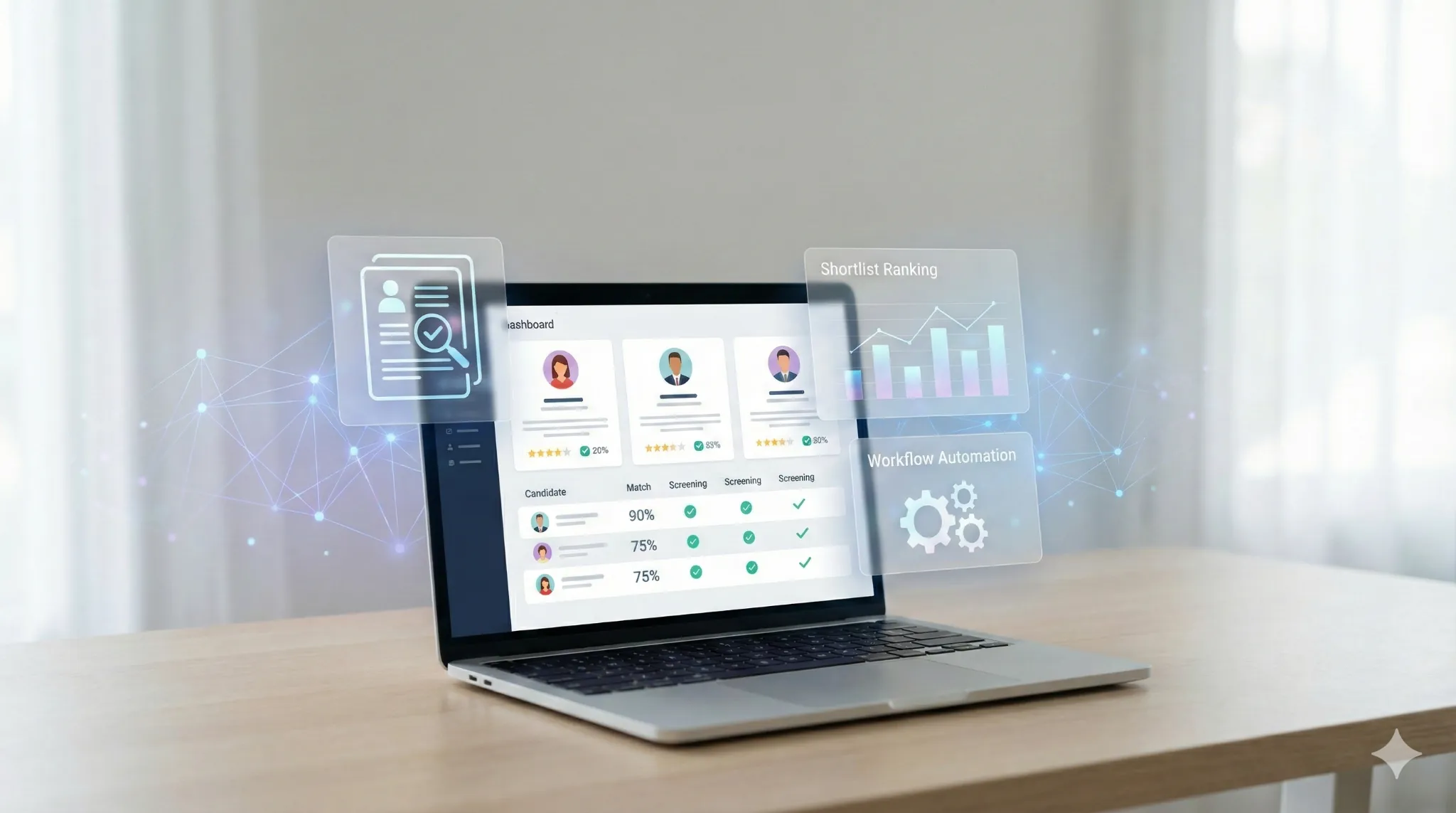
These toolsets also help in the initial evaluation, comparing candidate qualifications to job requirements and past successful hire patterns. Companies using AI-assisted matching report a 9% higher likelihood of making a quality hire, in part because recruiters spend their time evaluating the right candidates rather than sifting through noise. Benchmark IT’s AI Screening and Interviewing platform, called “Alex,” helps in this process by using AI to compare the resume to the position description and certain criteria which we specify and prioritize, to “grade” the resume, so that our recruiters see the best-matching candidates first. Applicants are also given the opportunity to interview immediately (and on their time schedule, 24/7) for the position, and that interview is also graded by the AI – so the recruiter can review and engage quickly with candidates who seem to be a good fit. At that point, again, the human interaction is key to having a real conversation, getting to know the candidate, and having an interactive session to help mutually determine if this is indeed a good match.
“I’ve found that many candidates who are unqualified for the role, that might be out there spam applying to a bunch of jobs, I feel like they are hesitant to take the AI interview because they probably know they are not going to do very well,” said Mariah Szarek, Director of Recruiting at Benchmark IT.
Another beneficial use of AI has been in note-taking. Instead of trying to hold a conversation and write down key points simultaneously, the AI produces word-for-word transcriptions of meetings, freeing recruiters from back-and-forth emails, flipping through notepads, and documenting the database afterwards. By taking this manual task off recruiters’ plates, they are able to spend more time understanding a candidate, including their goals, preferences, strengths, and weaknesses. This ends with better matching for candidates and hiring companies.
“We use an AI notetaker called Quil, which attaches to our team’s video interviews. It gives us a recording of the call and a transcript of the call with the candidate… At this stage in the process, we’re now very focused on the fit for the position we are trying to fill. We’re very focused on their skills, their experience, and what the candidate is looking for, and the notetaker helps us ensure we capture everything in the interview. So when we go back to represent them to the client, we’ve captured more good information than we might have before. Plus, the notetaker loads information into the database for future reference. So our knowledge of the candidate is a lot more rich than it used to be,” said John Bemis, Benchmark IT CEO.
The benefit of these automated tasks continues with messaging, helping workflows continue with timely updates, next steps, and reminders – which helps prevent the candidate drop-off that often happens during periods of silence.
In each of these cases, AI serves the process by reducing friction, not replacing the recruiter. Automation doesn’t diminish the importance of the recruiter – it simply gives them more time to do what matters most: talk to people.
Where the Human Recruiter Remains Essential
It’s clear AI is a useful, and even necessary tool. However, that is where it stops. Recruitment remains a service that requires the skills and expertise of industry recruiting professionals. The most meaningful parts of the hiring process require interpretation, intuition, and understanding – qualities that are deeply human.
Consider cultural fit. A candidate may align perfectly on technical skills and project history, yet still struggle to thrive if the team environment or communication dynamics don’t match their working style. This is not something an algorithm can reliably detect. Only a conversation – one with tone, nuance, and follow-up questions – reveals whether someone will succeed beyond the job description.
Similarly, recruiters play a vital role as advocates and translators. They help candidates understand role expectations, growth opportunities, and organizational personality. They help clients articulate what they really need, not just what the job posting says. And they broker crucial moments in the hiring lifecycle – from offer negotiation to start-date alignment to long-term retention planning.
Recruiters also carry the emotional labor of hiring. They reassure nervous candidates, navigate competing offers, and support individuals navigating career change. These are deeply human experiences – and they are where long-lasting trust is built.
“We’re in the people business. That’s our main reason for being here – to help our clients and candidates, not to just implement technology,” said Bemis.
AI may accelerate the mechanics of hiring. But human recruiters shape the experience and the outcome.
Where AI Creates Blindspots in Modern Recruiting
AI is powerful – but if used without oversight, it can unintentionally create blind spots that undermine fairness and effectiveness.
Because AI learns from past hiring patterns, it may unconsciously replicate historical bias. If certain roles have traditionally been filled by individuals from similar educational backgrounds, industries, or locations, AI may infer that pattern as a preference and filter out equally capable but less conventional candidates. This risks narrowing talent pipelines rather than expanding them.
“Old data” and traditional filters can hinder the candidate experience and limit organizations from the best available talent. When candidate profiles have to be updated and managed on a regular basis by recruiters, things can fall through the cracks. This creates a disconnection between a candidate’s active career desires and what roles they may best fit at an organization.
Benchmark IT uses automation to keep in touch with candidates and allow them to update their resume and career interests in the system, which can result in a better match, than working off old data and old resumes which don’t reflect a candidate’s experience and current objectives.
AI can also misinterpret or undervalue non-linear career paths. Career changers, self-taught technologists, contractors with varied project histories, and those returning from caregiving leaves may not fit neat résumé patterns – but they often bring adaptability, problem-solving, and resilience that outperform traditional candidates. An algorithm trained on resume keywords may never surface them.
And while AI can evaluate what someone has done, it cannot evaluate why. Motivation, curiosity, humility, leadership maturity – these are the qualities that often determine long-term success, and they are best revealed through dialogue.
This is why Benchmark IT has a policy of a human review on every shortlisting decision, and a thorough video interview with every candidate before presenting them to a client for an opportunity. AI can suggest, but humans decide, and use their best professional judgement to suggest candidates who could be a very good fit.
How Candidates View AI in the Hiring Process
Candidates increasingly recognize when AI is being used – and their reactions vary. On the positive side, candidates often appreciate faster response times and clearer process flow. For many, AI reduces uncertainty and improves transparency around next steps. Tech professionals also tend to be comfortable with digital tools, and many view AI-supported processes as modern and efficient.
However, candidates also express concerns about feeling de-personalized. They worry that an automated score may determine their chances before they’ve had the opportunity to express who they are. Candidates with non-traditional backgrounds, global accents, or varied career histories sometimes express fear that AI may overlook their potential.
“I think first and foremost, this is very new. So people are a little nervous about the unknown… I have received feedback from candidates who worry how fair it is. They think they are going to be screened out by AI. The message I want to get clear to them is that we are not having AI make any definitive decisions on candidate status. That is something that is left all up to the humans here at Benchmark IT,” said Mariah Szarek, Director of Recruiting at Benchmark IT.
A recent survey found that while 72% of candidates support AI speeding up the hiring process, 81% believe a human should make the final decision. Candidates want efficiency – but they also want fairness, nuance, and conversation. In top recruiting firms, this blend is possible, and in effect. By ignoring the infusion of artificial intelligence into the workflow, firms do both themselves and candidates a disservice. The use of AI tools helps speed up timelines, ensure better information accuracy, and enrich the candidate database for both present and future placements.
This reinforces a simple truth: candidates don’t object to AI – they object to feeling invisible.
That’s precisely why the human recruiter will remain essential to hiring the right candidate for the right role.
The Future of Hiring: A Hybrid Model With Benchmark IT
When AI accelerates the process and humans guide the judgment, the hiring experience becomes faster, smarter, and more personal. Recruiters gain more time to engage deeply. Candidates feel seen and supported. Clients receive better-aligned talent.
This is the approach Benchmark IT takes every day.
Because great recruiting has never been about automation vs. people. It has always been about using every tool available to bring the right people together in the right way.
TAGGED WITH → Uncategorized